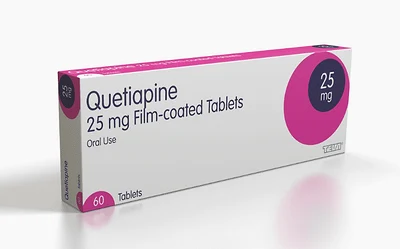
An antipsychotic used in schizophrenia, in both phases of bipolar disorder, and as an add-on in depression. It is effective across that range. It also causes substantial weight gain and metabolic change in many people, which is why it requires monitoring rather than simply being swallowed.
Quetiapine blocks dopamine D2 receptors, which is the core antipsychotic action, and serotonin 5-HT2A receptors, which reduces the movement side effects that older antipsychotics caused. It also blocks histamine receptors strongly — hence the sedation — and has an active metabolite that inhibits noradrenaline reuptake, which contributes to its antidepressant effect.
That mixed profile explains why one drug covers psychosis, mania, bipolar depression and augmentation in unipolar depression.
Dose determines the purpose
At low doses — twenty-five to fifty milligrams — the antihistamine effect dominates and it is effectively a sedative. It is widely used this way for insomnia, which is off-label and exposes people to the metabolic risks for a purpose that other drugs could serve.
At one hundred and fifty to three hundred milligrams it acts as an antidepressant in bipolar depression. At four hundred to eight hundred it is an antipsychotic dose for schizophrenia and mania.
So the dose tells you a great deal about what is being treated.
The metabolic problem
Weight gain with quetiapine is often substantial — several kilograms in the first months, continuing afterwards. Blood sugar and lipids rise, and the risk of developing type 2 diabetes increases meaningfully.
This is the main long-term harm of the drug and it is manageable only if it is measured. Weight, waist circumference, blood pressure, fasting glucose or HbA1c, and a lipid profile before starting and at intervals afterwards.
Taking quetiapine for years without any of those checks is common and is the scenario in which real damage accumulates quietly.
Sedation
Marked, particulary at the start and at lower doses. Taken at night, which is where most of the dose belongs.
It wears off somewhat with time but not entirely. Driving requires knowing how it affects you, and combining it with alcohol or other sedatives is a poor idea.
Blood pressure on standing
Quetiapine blocks alpha-1 receptors, which causes a drop in blood pressure on standing — dizziness, light-headedness, and falls in older people. It is worst during dose increases, which is why titration is gradual.
Standing up slowly for the first weeks is practical advice rather than a formality.
Movement side effects and tardive dyskinesia
Less common than with older antipsychotics but not absent. Tremor, stiffness, restlessness and an inner inability to keep still can all occur.
Tardive dyskinesia — involuntary movements, often of the face and mouth — can develop after prolonged use and may persist after stopping. Any new involuntary movement needs reporting promptly rather than at the next review.
Serious but rare effects
Neuroleptic malignant syndrome: high fever, muscle rigidity, confusion and autonomic instability. A medical emergency.
QT prolongation, relevant alongside other QT-prolonging drugs or with low potassium. And rarely, suppression of white cells, so fever and sore throat deserve a blood count.
How do you stop it?
Not abruptly. Discontinuation causes insomnia, nausea, agitation and sometimes a rebound of the original condition. Taper over weeks, more slowly after long treatment.
In bipolar disorder in particular, stopping a mood stabiliser abruptly carries a real risk of relapse, and that decision belongs with a psychiatrist rather than being made alone.
Who needs particular care
Older people with dementia, in whom antipsychotics increase the risk of stroke and death — they are used there only when clearly necessary and reviewed frequently. Anyone with diabetes, cardiovascular disease, epilepsy or a history of low white cell counts.
Pregnancy and breastfeeding need individual specialist advice rather than a general answer.
How to buy it without prescription in the UK
Pick a strength, pick a quantity, add it to the basket, then a UK address and a payment method. That is the whole sequence, and no prescription is requested at any stage.
Delivery arrives discreetly, in neutral packaging with nothing printed on the outside. The time it takes is set by the destination within the UK and by the service you choose.
Everything is priced in pounds. Cost tracks pack size above all — small quantities more per unit, larger ones less, with generics staying under the branded product. The breakdown sits with the pack sizes.