Many bacteria produce an enzyme that destroys amoxicillin before it can act. Clavulanic acid blocks that enzyme. The combination works where plain amoxicillin fails — and it is noticeably harder on the digestive system, which is the trade.
Penicillins work by disrupting the bacterial cell wall. In response, many bacteria produce beta-lactamase, an enzyme that cuts the penicillin molecule apart before it can do any damage. Those organisms are effectively immune to plain amoxicillin.
Clavulanic acid is a decoy. It binds to beta-lactamase and disables it, leaving the amoxicillin intact to do its work. It has almost no antibacterial action of its own — its entire job is protecting the other ingredient.
When it is used rather than plain amoxicillin
Sinus and ear infections that have not responded to first-line treatment. Chest infections in people with underlying lung disease. Animal and human bites, where the bacteria involved are usualy resistant. Dental abscesses. Some urinary and skin infections.
It is deliberately not a first choice for simple infections. Using a broader antibiotic than neccessary drives resistance and upsets the gut for no gain.
Where should the dose start?
Adults usually take one tablet twice or three times daily depending on the strength and the infection. The ratio of the two ingredients differs between tablet strengths, which is why tablets should not be combined or split to improvise a dose.
Take it at the start of a meal. This matters more than with most antibiotics — it improves absorption and significantly reduces the nausea.
It upsets the stomach more, and here is why
Clavulanic acid itself irritates the gut and alters bowel bacteria. Diarrhoea is substantially more common with this combination than with amoxicillin alone, and it is the main reason people abandon a course.
Taking each dose with food helps considerably. If diarrhoea becomes severe, watery or bloody, particularly with fever or cramping, that needs medical attention rather than an antidiarrhoeal — Clostridioides difficile overgrowth is a real risk with broad antibiotics.
The liver point
This combination causes liver inflammation more often than most antibiotics. It is uncommon, usually reversible, and more likely in older people and on longer courses.
Yellowing of the eyes or skin, dark urine, pale stools, persistent nausea or pain under the right ribs mean stopping and getting seen. Anyone who has had liver trouble on it before should not take it again.
Penicillin allergy rules it out
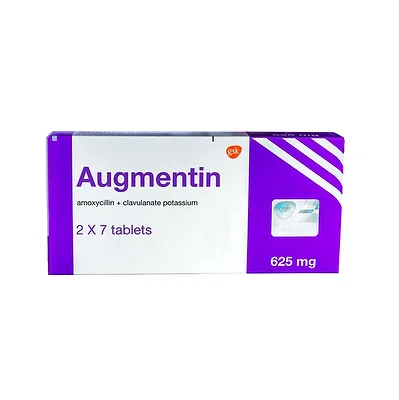
Augmentin contains amoxicillin, so every penicillin allergy warning applies in full. Previous reaction to any drug ending in cillin means this is not an option.
Facial or tongue swelling, breathing difficulty, wheeze, widespread hives or faintness require emergency treatment, not a wait-and-see approach.
What interacts with it?
Methotrexate levels rise. Warfarin control becomes less predictable. Allopurinol increases rash risk. If vomiting or diarrhoea occurs, oral contraceptive reliability may be reduced for that cycle.
Finish the course, and do not keep leftovers
Stopping as soon as you feel better leaves the most resistant bacteria alive, which is exactly the population you did not want to select for.
Equally, a half-used pack kept in a drawer for the next time is a bad idea. The next infection may be viral, or may need something else entirely, and guessing from a leftover box is how resistance spreads.
How to buy it without prescription in the UK
Pick a strength, pick a quantity, add it to the basket, then a UK address and a payment method. That is the whole sequence, and no prescription is requested at any stage.
Delivery arrives discreetly, in neutral packaging with nothing printed on the outside. The time it takes is set by the destination within the UK and by the service you choose.
Everything is priced in pounds. Cost tracks pack size above all — small quantities more per unit, larger ones less, with generics staying under the branded product. The breakdown sits with the pack sizes.